Case

0.0The average rating is 0 stars out of 5.

Fully Guided and Minimally Invasive Implant Placement as the Basis for Effective Digital Fabrication of a Tapered-Crown Full-Arch Prosthesis

Pauline Gutmann, Puria Parvini, Paul Weigl

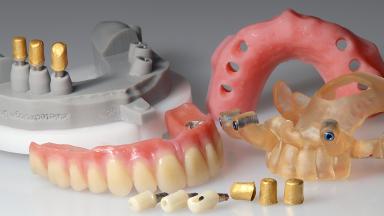
A 74-year-old male patient presented to the Department of Oral Medicine at the Goethe University in Frankfurt, Germany. The patient had been edentulous for 15 months and had been treated with a complete denture by students in the undergraduate program. During a recall appointment, the patient complained of poor retention of his maxillary complete denture. The prosthetic site consisted of a rigid and thick maxillary ridge with an undercut in the left posterior region. The prosthesis covered the entire palate and was dislodged by biting on solid foods such as apples. The patient did not have high esthetic expectations, but he did want improved chewing comfort and "fixed teeth".
Surgical classification
Complex
Prosthodontic classification
Complex
Source
Treatment Guide 15
Purchase price
10 Academy Coins
CPD/CME
25 hours

General Risk Assessment

Patient-related Factors
Oral hygiene Good
Compliance Good
Patient-medical Factors
Medical Fitness Healthy, able to undergo planned anesthesia and surgical procedure (ASA I)
Medications No medications that would negatively affect the surgical procedure and outcomes.
Radiation Treatment None
Growth Status Complete
Site-related Factors
Access Adequate
Pathology near the implant site None
Previous surgeries in planned implant site No previous procedures.

Surgical Classification

Surgical Complexity
Timing of placement Healed (Type IV)
Simultaneous or Staged grafting procedures Implant placement without adjunctive procedures
Number of implants > Three
Anatomy
Keratinized Tissue Sufficient (>4 mm)
Soft Tissue Quality No scars or inflammation
Proximity to vital anatomic structures Minimal risk of involvement

Prosthodontic Classification

Complicating Factors
Biological Screw-retained restorations with appropriate contours
Mechanical/Technical Absence of contributing factors
Planned contour of tissue-fitting surfaces Appropriate contours (hygienic - accessible for maintenance)
Prosthesis Factors
Prosthetic volume Adequate. Space available for ideal anatomy of the restoration
Inter-occlusal space Adequate. Capable to create an anatomically & functionally correct planned restoration
Occlusal Factors
Occlusal scheme User-defined occlusal scheme achievable
Involvement in occlusion Involvement
Occlusal parafunction Absent
Complexity
Loading Protocol Early/Conventional
Interim prosthesis Tissue or interim implant supported
Number of implants >2 (non-splinted) or ≥ 2 (splinted)
Timing of placement Healed (Type IV)

Esthetic Risk Assessment

Edentulous Esthetic Risk Assessment (removable)
Facial Support Desired tooth position provides sastifactory labial support
Labial Support Flange provides required lip support
Upper Lip Length Long upper lip (>20mm)
Buccal Corridor Wide corridor
Smile Line No display of the Maxillary ridge at full smile
Maxillomandibular Relationship Class I
Publication date: Dec 9, 2025 Last review date: Dec 2, 2025 Next review date: Dec 2, 2028

ITI QR code Mvc

Share this page

Download the QR code with a link to this page and use it in your presentations or share it on social media.

Download QR code
QR code